Geography Class 09
Last class revision (5:09 PM)
Interior of the earth (5:20 PM)
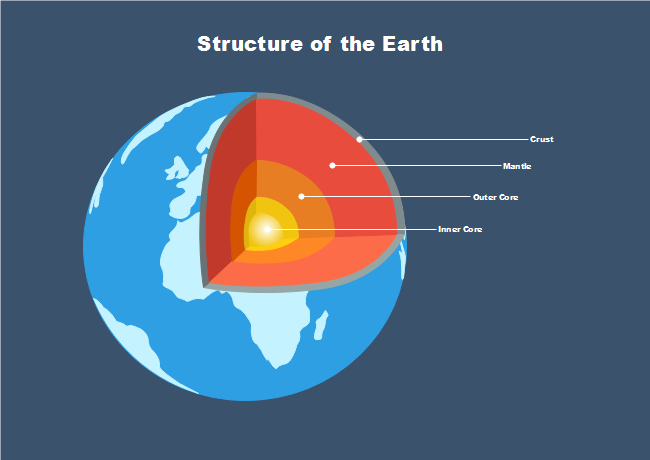
- The diagrammatic representation of the interior of the earth:
- The chemical divisions of the earth's interior:
- The 3 layers of crust, mantle, and core are the chemical division of the earth.
- Crust:
- It is the uppermost layer of the earth.
- It is made up of light elements such as silica, aluminium, magnesium, etc.
- It is the lightest in terms of density.
- It is of 2 types, continental crust, and oceanic crust.
- The difference between the continental crust and oceanic crust:
-
Continental crust: Oceanic crust: Very thick(35-45 km) Very thin(8-10 km) Lighter in density. Heavier in density. Rocks of brighter colour. Rocks of darker colour. Rocks are older Rocks are younger It is richer in Alumium, sodium, and Potassium elements(SiAl layer) It is richer in Magnesium, calcium, and Iron. (SiMa layer) - Mantle:
- It is lighter than the core and denser than the crust.
- It accounts for 83% volume of the earth.
- It consists of 68% of the mass of the earth.
- The overall depth of the mantle extends to 2888 km.
- The mantle contains a higher proportion of magnesium and a lower proportion of silica and aluminium.
- It is divided into the upper and lower mantle.
- Core:
- It is the innermost and densest layer of the earth.
- It is rich in nickel and iron therefore it is also called as NiFe layer.
- It is divided into the inner core and outer core.
- The inner core is solid and the outer core is liquid as the pressure at the inner core is very high.
Physical division of the interior of the earth (5:58 PM)
- Lithosphere:
- It is a solid layer made up of Crust and the upper part of the Upper Mantle.
- It is a hard and rigid outer layer that is divided into different plates.
- The thickness of the lithosphere is nearly 100 Km.
- Asthenosphere:
- It extends between 100-400 km.
- It is in a semi-solid and semi-liquid state and undergoes deformation under pressure.
- It is also a source of magma on the surface.
- It is also called a low-velocity zone due to the slowing down of earthquake waves in this zone.
- Mesosphere
- It includes the rest of the Mantle.
- Barrysphere:
- It includes both the outer and inner core.
Composition of the earth (6:17 PM)
- Elements of the entire earth:
- Iron: 35%
- oxygen: 30%
- Silicon- 15%
- Magnesium: 13%
- Major Elements of the Earth's Crust:
- Oxygen: 46.60%
- Silicon: 27.72%
- Aluminium: 8.13%
- Iron: 5%.
Discontinuities in the interior of the earth (6:21 PM)
- It is the transition zone between the different layers of the earth's interior with different physical and chemical characteristics.
- Diagramatic representation of discontinuities:

- There are mainly 5 types of discontinuities:
- Conrad Discontinuity:
- It is Within the Crust (Upper and Lower Crust).
- Mohorovicic or Moho Discontinuity:
- It is Between Crust and the Mantle.
- Repetti Discontinuity:
- It is Between the Upper and the Lower Mantle.
- Guttenberg Discontinuity:
- It is Between Mantle and Outer Core.
- Lehmann Discontinuity:
- It is Between the Outer and Inner Core.
Types of rocks (6:32 PM):
- Any naturally occurring aggregate of minerals is called a rock.
- Difference Between Rocks and Minerals:
-
Rocks: Minerals: Rocks are an aggregate of mineral elements. Minerals are solid inorganic substances occurring naturally. A rock has no definite chemical composition Minerals have a definite chemical composition. Minerals are organized to form rocks. Elements are organized to form compounds that are known as minerals. An element is a pure substance. The three chief types of rocks are- Igneous, Sedimentary, and metamorphic. Four chief mineral groups are- Silicates, Carbonates, Sulphides, and metallic minerals. Basalt, Granite, Sandstone, Slate, and Quartz are some important types of rocks. Iron, Silicon, Magnesium, Nickel, and Calcium, are abundant minerals of the earth.
Types of rocks (7:02 PM)
Igneous rocks:
- They are formed due to the cooling, solidification, and crystallization of molten material from the earth's interior.
- They are also called primary rocks.
- Igneous rocks are of two types, intrusive and extrusive igneous rocks.
- Intrusive igneous rocks:
- They are formed from the cooling of magma inside the earth.
- The slow cooling of magma results in a crystalline texture with higher strength.
- They are also called Plutonic rocks.
- Examples are granite, Gabbro, etc.
- Extrusive igneous rocks:
- They are formed due to the cooling of magma above the earth's surface.
- Faster cooling results glassy texture but with lower strength.
- They are also called Volcanic rocks.
- Examples are Basalt, Andesite, etc.
- Igneous rocks are also be classified as:
- Acidic or Silsic:
- Where the silica percentage is more than 66%.
- For example Granite.
- Basic or Mafic:
- Where the silica percentage is less than 52%.
- For example Basalt.
Sedimentary rock (7:29 PM)
- These are the secondary rocks formed by the solidification of sediments of original igneous or metamorphic rocks or another sedimentary rock.
- Stages in the formation of sedimentary rock:
- Weathering>>Transportation(by a different agent such as wind, water, glacier, etc)>>Deposition(in a basin)>>Lithification( conversion of loose sediments into hard rock)>>Compaction(sediments are squeezed by the weight of overlying layers)>>Cementation(It involves binding together of compacted sediments by natural cementing material such as silt).
- Sedimentary rocks are formed in different layers or strata.
- They contain fossil evidence.
- Examples of sedimentary rocks are Sandstone, Limestone, Shale, Clay, Chalk, Coal, and Gypsum.
Metamorphic rock (7:47 PM)
- Metamorphism involves changes in the form of rocks through physical or chemical processes.
- The change in pressure conditions results in dynamic metamorphism and the change in temperature results in thermal metamorphism, together it causes thermo-dynamic metamorphism.
- During the process of Metamorphism if the minerals are arranged in a series of bands along a plain it is called foliation.
- foliation involves banding.
- When minerals are arranged linearly it is called Lineation.
- Examples of Metamorphics rocks:
- Granite resulting in Gneiss.
- Limestone resulting in Marble.
- Sandstone resulting in Quartize.
- Shale resulting in Schist.
- Clay resulting in Slate.
- Coal results in Graphite and Diamonds.
The Rock Cycle (8:01 PM)
- The diagrammatic representation of the Rock cycle:
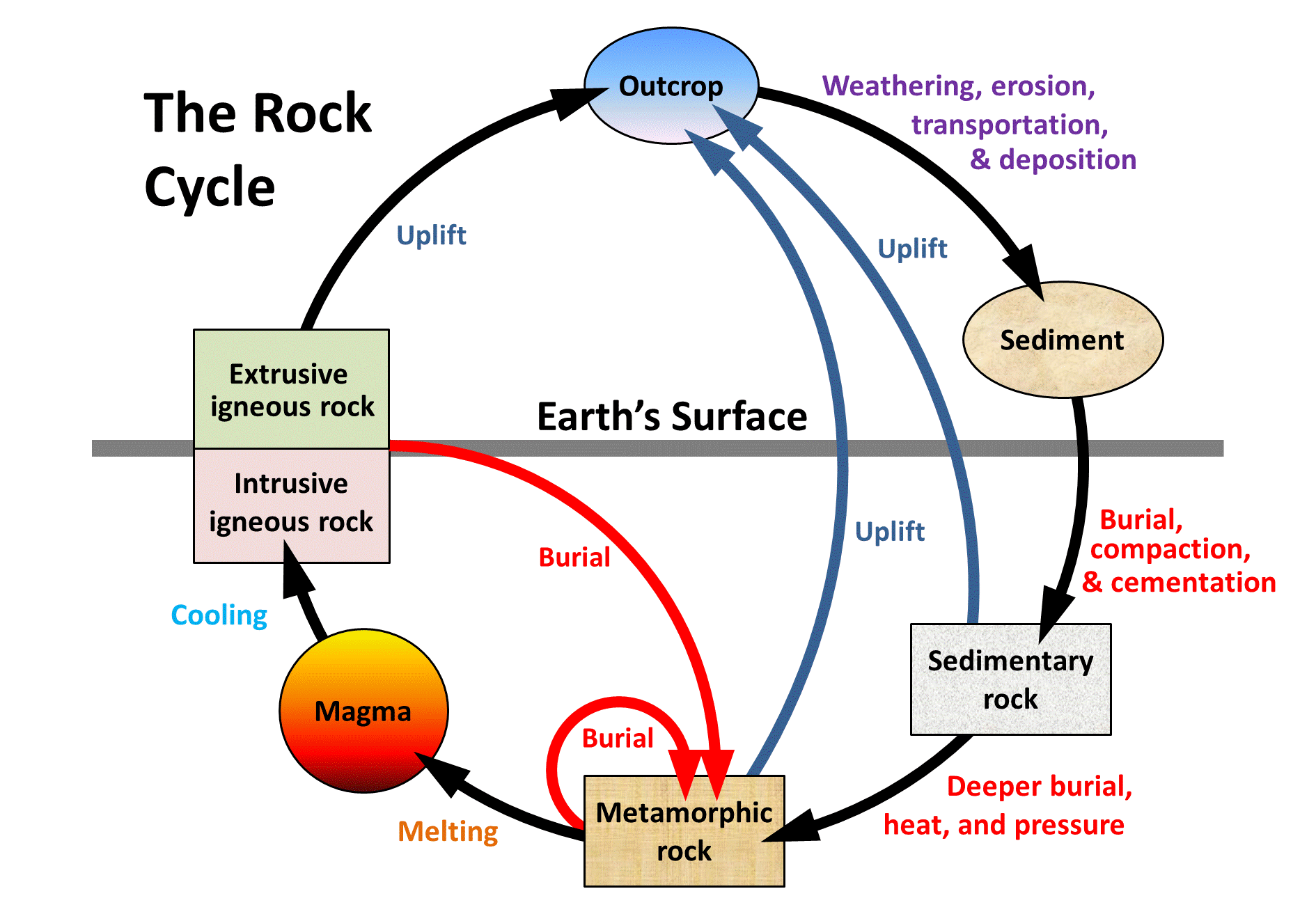
- In nature, all the rocks get converted into each other form.
- The outcrop is the elevated part of the surface thus it undergoes weathering very easily.
The topic for the next class: Earth's Movements.